
- Salt Lake City reached 95% of its goal to save 10 million gallons daily.
- The city reduced water use by over 2 billion gallons amid record heat and ongoing growth.
- Officials praised community efforts from voluntary restrictions introduced after record-low snowpack.
SALT LAKE CITY — Utah's capital city fell short of its goal to save 10 million gallons of water daily for the bulk of the irrigation season.
However, leaders of the Salt Lake City Department of Public Utilities say it still managed to reduce water consumption by more than 2 billion gallons of water this season.
Thus, it still reached 95% of its goal, despite most of the restrictions being voluntary and this summer being Utah's hottest since at least 1895.
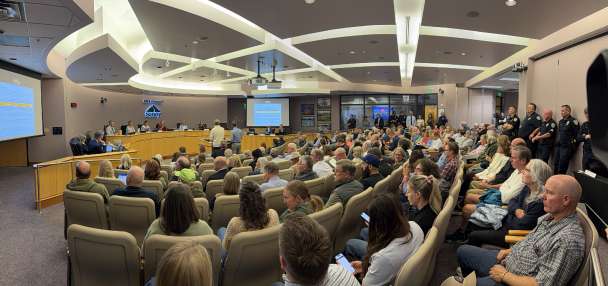
"Given the size of the area, the temperatures this summer, how dry it was ... that's a phenomenal response from our community in terms of a drought response," Salt Lake City conservation program manager Stephanie Duer said as she presented water data to city leaders last week.
As of Oct. 31, a little more than 20.5 billion gallons of water had been used within the Salt Lake City Department of Public Utilities' service area — a 4.8% decrease from the three-year average. The department provides water to Salt Lake City, as well as portions of or all of Cottonwood Heights, Holladay, Millcreek and Murray.
Salt Lake City had set a goal of saving over 2.1 billion gallons of water back when Salt Lake City Mayor Erin Mendenhall announced in March that the city would move back to Stage 2 of the city's five-stage water shortage plan. It was in response to what ended up being the state's record-low snowpack, which accounts for 95% of the state's water supply.
The plan only calls for mandatory reductions within city-owned facilities, which account for less than 5% of system use.
Over 95% of the agency's water goes to more than 90,000 residential or commercial customer connections, representing approximately 360,000 residents and 14,000 commercial entities who were given voluntary guidelines.
While the total fell short of the goal, it marked a 7.3% decrease from the water consumed at the same point last year, a figure that had risen each of the last two years after a record-high snowpack in 2023.
That's despite the official city thermometer hitting a high of 109 degrees for the first time on record this summer, one of 20 triple-digit days — tied for the fifth-most over the city's past 152 years. Salt Lake City's average temperature was the seventh-highest on record, while the state broke a record.
"(We used) less water this summer than we did in the summer '25, '24, '23, three-year average, five-year average and 2016," Duer said.
The reductions didn't necessarily save water because a chunk of the water not used didn't exist in the system because of the record-low snowpack. Not having that water added to the system this winter made the reductions so important, she added.
The Salt Lake City Department of Public Lands cut its year-over-year consumption by 4%. Part of that came from prioritizing hand-watering newly planted trees to help them survive during a pivotal time in their lifespans over irrigation watering, said Kim Shelley, the department's director.
"We only lost two trees, so that's a really big deal for the ... almost 1,000 we put in the ground over the last few months," she said.
She pointed out that long-term plans have called for replacing turf with lower-water alternatives within its portfolio, including golf courses.
The city's public lands officials reported carrying out replacements of faulty systems or making faucet changes that helped reduce water consumption at various city buildings, while adding new irrigation controllers at some of its facilities.
The numbers are encouraging, especially compared to 2000, Salt Lake City Councilman Dan Dugan said, as he pointed to the city's population increase during the same time.
He credits residents and city officials for each finding ways to improve water efficiency, but he and others on the council agree the work isn't over.
"We still have to continue to improve this because ... our reservoirs are still getting depleted because we're not getting the water," he said.