

- Retired Brig. Gen.Paul Peters experienced reduced PTSD symptoms after magnetic treatment.
- Transcranial magnetic stimulation helped Peters sleep better and manage anxiety effectively.
- Peters and Dr. Thomas Trevort advocate for awareness of this treatment for veterans.
MIDWAY — After serving in the Army National Guard for more than 30 years, Brig. Gen. Paul Peters retired in July of 2025. Even though he returned to civilian life, his experiences in the military followed him home.
Peters joined the National Guard in the 1990s at age 19, earning the rank of 1st lieutenant in 1997. He rose through the ranks over the next 25 years, serving five different deployments overseas in Kuwait, Afghanistan, Djibouti, Bahrain and Iraq.
He achieved the rank of brigadier general in 2022, the same year he was deployed to Iraq. After a final year overseas, he returned to the United States, serving in North Carolina and Virginia before retiring.
Nightmares and racing thoughts in the middle of the night plagued Peters for years even before retiring, but that was not the only impact his military service had left him with.
Peters said his anger management became more difficult throughout his career, leaving him fine one minute and "quite upset" the next. He was also hypervigilant everywhere he went, even when on vacation and on the weekends.
"High vigilance, high stress, high anxiety," Peters said. "It really affected about every interaction that I had."
Post-traumatic stress, which is caused by experiencing or witnessing an extremely stressful or terrifying event, can include intrusive memories, avoidance of similarly stressful situations, and negative changes in both mood and behavior, according to the Mayo Clinic.
These symptoms can fade over time after the stressful event, but sometimes the symptoms linger for long periods of time throughout a person's life.
When the symptoms last for longer than a month and negatively impact a person's ability to function, a medical professional can diagnose them with post-traumatic stress disorder. Approximately 13 million Americans were diagnosed with PTSD in 2020.
Peters' experience is not uncommon for veterans returning home after serving in the military. Approximately 6% of servicemen and 13% of servicewomen are diagnosed with post-traumatic stress disorder, according to the Department of Veterans Affairs.
"In the early 2000s, it was just expected to kind of, 'Suck it up, buttercup,' as we used to say, and kind of drive on," Peters said. "But as we started to learn more and more about the implications of PTSD ... I started to become aware and open my eyes to some of that."
Transcranial Magnetic Stimulation
While post-traumatic stress can be treated with therapy and medication, the impact the trauma had on the brain can be difficult to overcome. As medical technology advanced, scientists began experimenting with magnetic waves to learn about their impact on the brain.
The impact magnetic waves have on brains has been studied for years, according to Dr. Thomas Trevort, a nurse practitioner with Optimal TMS who studied neuroscience while obtaining his doctorate. Trevort said magnetic waves have been used medically since the 1980s.
Stress has been shown to damage parts of nerve cells called dendritic spines, which are used to help receive electrical impulses from other nerve cells. When the spines are damaged or destroyed, electrical impulses within the brain have a harder time properly sending signals from one area to another.
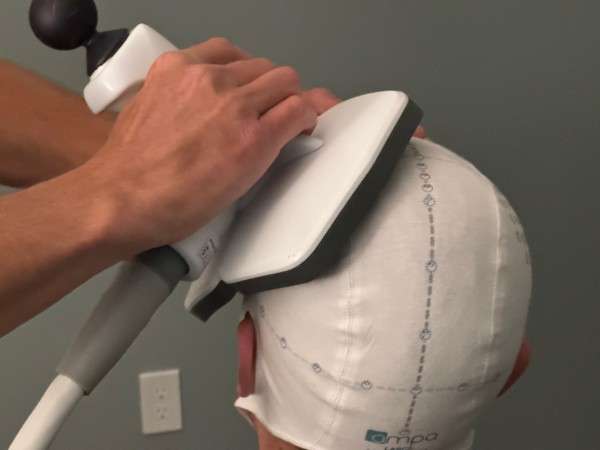
Transcranial magnetic stimulation pulses magnetic waves to specific areas of the brain. Testing has shown that the waves will help regrow dendritic spines within the targeted area, allowing previously damaged nerve cells to return to full function, Trevort said.
The Federal Drug Administration approved transcranial magnetic stimulation to treat medication-resistant depression in 2008 after years of studies. Ten years later, it was approved to treat obsessive-compulsive disorder.
Research has shown that the treatments have an 80% chance to improve symptoms of depression and obsessive-compulsive disorder when medication and other treatments have failed. The Mayo Clinic said risks of the treatment are very low, even among those unaffected.
The traditional treatment program for transcranial magnetic stimulation lasted for 36 days, five days a week, according to Trevort. Medical technicians would place an electromagnetic coil against a person's scalp and trigger magnetic pulses during sessions lasting between 10 and 30 minutes.
As additional research has continued into the technology, newer treatment methods have emerged, including ways to shorten the traditional treatment program to as little as a single day-long session.
Impact on veteran PTSD
Peters said he was initially skeptical of the treatment, and even immediately following the treatment, he asked himself, "Hey, has anything changed?" However, that night, he was able to fall asleep and "really, truly sleep for the first time" in years.
Peters said both his wife and his therapist noticed an immediate change in his behavior following treatment. He added that he became much more himself than he had been in a long time.
"Things still frustrate me, but I don't get upset when they frustrate me," Peters said. "I am still driven to get things done, but I don't have this lingering anxiety about how they're getting done or the timeliness. ... It's very positive."
After seeing the beneficial changes in his life, Peters and Trevort, who also underwent treatment, want to spread awareness of the procedure to other veterans who may be struggling with PTSD.
"I want people to know about the treatment more than anything else," Trevort said, "because knowledge gets people to start looking, and that's what matters most."