
Estimated read time: 2-3 minutes
This archived news story is available only for your personal, non-commercial use. Information in the story may be outdated or superseded by additional information. Reading or replaying the story in its archived form does not constitute a republication of the story.
SALT LAKE CITY — A Utah lawmaker's own experience with a speeding ticket is prompting him to look at changing laws surrounding speed traps and where the money goes.
Rep. Jacob Anderegg, R-Lehi, said Tuesday he opened a bill file and was considering running a measure in the upcoming session that would require officers to note where they are in relation to speed signs and cars they stop when they ticket drivers within 1,000 feet of a sign placement noting a change in the speed limit.
"With their [speed] gun — when they shoot it — they should be able to say 'this is the distance of the vehicle when it was speeding at this time," Anderegg explained.
Anderegg said he also was considering blocking cities and counties from using speeding ticket revenue in general funds.
"[It's] so that there isn't the incentive for law enforcement officers to bend the rules," Anderegg said.
Anderegg said he still was debating whether to run the legislation, and there were certain issues related to a potential bill that he would like to discuss with law enforcement first.
One of those issues, he said, is that newer radar guns record distances, but older ones do not — meaning potential implementation challenges across the state.
Anderegg himself received a speeding ticket earlier in the year in an area in Utah County close to a speed zone change.
Court documents show an officer recorded Anderegg driving 71 in a 35 mile-per-hour zone.
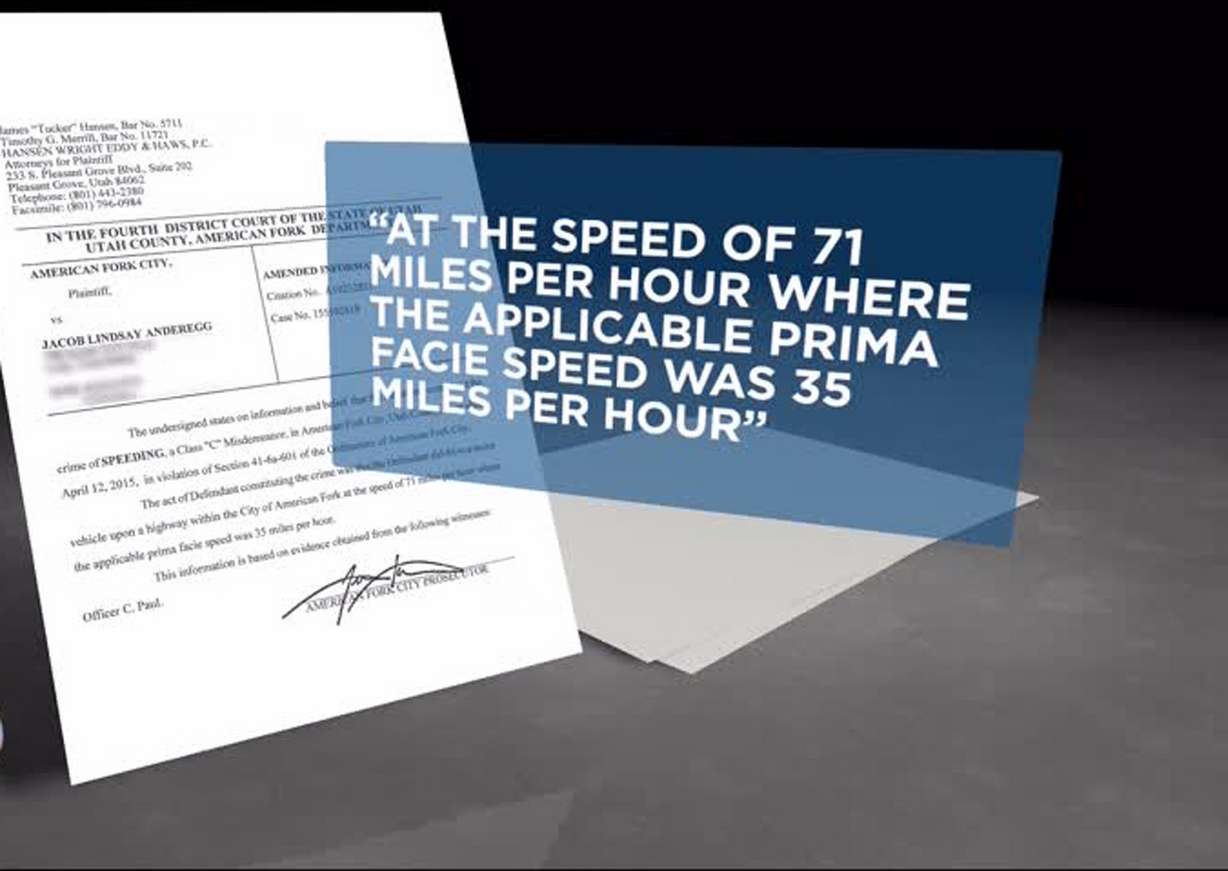
Anderegg — who admits he was traveling at 60 to 65 mph and ultimately paid a hefty fine after fighting and losing the matter in court — still maintains the officer was pointing his radar gun back to an area governed by a higher speed limit.
"The cop was sitting right there about a hundred feet beyond that [sign], shooting into the 50-mile-an-hour zone and tagging people, saying 'you're speeding,' in a 35-mile-an-hour zone," Anderegg said. "I couldn't prove where he was, because I don't have a dash cam."
The police department involved in Anderegg's case had not returned a call to KSL as of Tuesday night.
An official with another law enforcement agency told KSL in general terms, boots-on-the-ground officers are generally not told about revenue issues. The officer said he often will give drivers the benefit of the doubt when he pulls them over close to speed zone changes.
Anderegg said he subsequently heard from additional drivers who claimed they had similar experiences in other parts of the state, which ultimately led him to consider legislation.
"It's a citizen's word versus the law enforcement, and how can I prove it in a court of law," Anderegg said.